
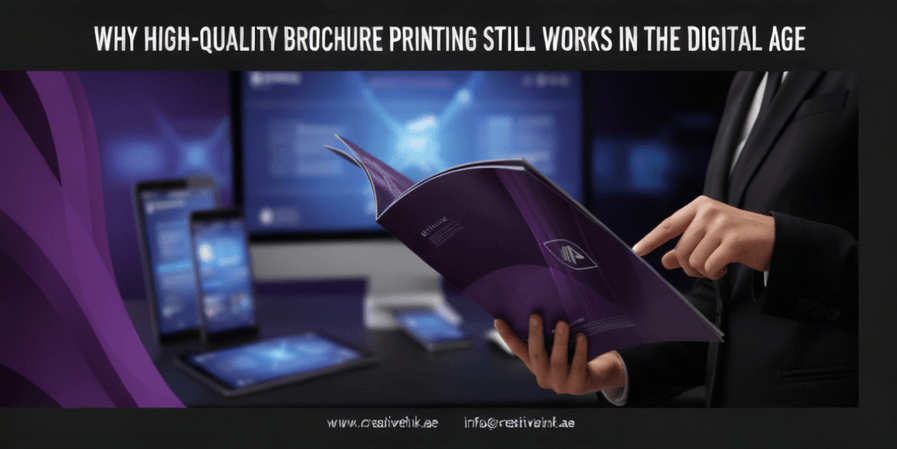
Why High-Quality Brochure Printing Still Works in the Digital Age
Somewhere between the fourth unskippable ad and the third promotional email of the morning, something shifted. People stopped absorbing digital content and started ignoring it by reflex. Yet walk into any hotel lobby, clinic waiting room, or trade show floor, and the brochure on the counter still gets picked up. Still gets slipped into a bag. Sometimes even gets read cover to cover.
That’s not nostalgia. That’s attention economics.
The brands investing in high quality brochure printing right now aren’t behind the times. They are ahead of the noise. Physical print doesn’t fight an algorithm. It doesn’t compete with a notification. It just sits there, in someone’s hands, doing exactly what it was made to do.
What Screens Can’t Do That Printed Brochures Can
Think about the last time you actually read a digital ad. Not scrolled past it, read it. Most people can’t remember because the brain learned to filter it out years ago.
A brochure doesn’t have that problem. It doesn’t get sent to spam. There’s no “skip in 5 seconds.” Nobody marks it as read and forgets about it. At a real estate open house, it sits on the kitchen counter after the agent leaves. At a spa, it’s already in someone’s handbag before they’ve booked anything. At a trade show, it travels home in a tote bag full of decisions waiting to be made.
Print works in the spaces where screens feel intrusive, face-to-face moments, quiet waiting rooms, first impressions with our creative designers that need to feel considered rather than convenient.
What Makes a Brochure Worth Keeping
Not every brochure does the job. Some get glanced at and dropped. Some make a brand look cheaper than it actually is. The difference usually isn’t the concept. It’s the production.
A few things that quietly decide whether a brochure stays or goes:
- Paper weight: Thin paper feels like an afterthought. A heavier stock feels considered, worth holding onto.
- Finish: Matte works for premium and professional. Gloss catches light and suits product-heavy layouts. Neither is wrong, but picking the wrong one for your brand is.
- Fold type: A bi-fold gives you space. A tri-fold organizes information. A z-fold creates a journey. The structure should match the content, not just the budget.
- Image resolution: What looks sharp on a screen can print blurry. Low-res images on a brochure signal carelessness faster than any typo.
- Ink quality: Faded or streaky print undermines everything else on the page.
This is exactly where high quality brochure printing makes the real argument for itself, not as a luxury but as the baseline for anything worth handing to a potential customer.
A flimsy tri-fold with washed-out images doesn’t just fail to impress. It actively works against the brand it was meant to represent.
You Don’t Need a Bulk Order to Get Started
One of the biggest reasons small businesses avoid print is the assumption that it requires a massive upfront commitment. Order 5,000 copies, hope the pricing doesn’t change, and watch half of them go out of date within a season.
That’s not how it works anymore.
Print on demand brochures changed the equation entirely. A boutique hotel can print a weekend-specific offer. A clinic can update its service list without scrapping a warehouse of old stock. A freelancer heading to a networking event can order exactly 30 copies of the right version for the right room at the right time.
This kind of flexibility matters most when details shift often, such as seasonal promotions, new team members, revised pricing, and event-specific messaging. Instead of committing to a run that goes obsolete, businesses now print what they need, when they need it.
Small run doesn’t mean low quality. It just means smarter timing.
Design Mistakes That Print Can’t Fix
Good print can’t rescue a bad layout. Before anything goes to press, the design itself has to be honest about what it’s doing.
The most common mistake is treating a brochure like a webpage, filling every panel with text because the space is there. Readers don’t work through a brochure linearly. They scan, they land somewhere, and if nothing catches them in the first few seconds, they’re done. Copy needs to be cut to the point where every line is earning its place.
Technically, wrong bleed settings and font sizes that look fine on screen but shrink to unreadable in print are what turn a decent design into a reprint bill. These aren’t design theory problems. They are production knowledge gaps. Working with design and printing services that understand both sides of the process closes that gap before it costs anything.
The CTA also gets buried more often than it should. If someone has to hunt for what to do next, most won’t bother.
FAQs!
Are brochures still effective for marketing in 2025?
Yes, especially in face-to-face industries like real estate, hospitality, and healthcare. Physical print cuts through digital noise in ways online ads simply can’t.
What is the benefit of print-on-demand brochures for small businesses?
They let small businesses print exactly what they need. No bulk orders and no wasted stock. Pricing, seasonal offers, and messaging can be updated without starting from scratch.
How do I choose the right design and printing services for my brochure?
Look for a provider that handles both design and production. Teams that understand print specifications, bleed settings, paper weight, and ink quality prevent costly mistakes before they reach the press.
Where a Brochure Outperforms a Website
There are industries where handing someone a URL just doesn’t land the same way.
A real estate agent leaving a property brochure on the kitchen counter after a viewing gives the buyer something to return to that evening, something to hand a partner, point at, and discuss. A dental clinic with a well-produced services brochure in the waiting room answers questions before the receptionist has to. A hotel that leaves a spa menu on the bedside table sells treatments without saying a word.
Tour operators, local service businesses, or event organizers. Anywhere the sale happens face-to-face, print carries weight that a QR code redirecting to a website simply doesn’t. It feels considered. It signals that the business invested in the impression it leaves behind.
In high-trust moments, people don’t want to be sent somewhere. They want something in their hands.
That’s the gap high quality brochure printing still fills, and probably always will.

As a seasoned content creator for Creative Ink UAE, I write about everything from cutting-edge design tips to print marketing best practices. Drawing from experience with Dubai’s top design and printing agencies, I aim to educate and inspire business owners and creatives with blog posts that simplify complex topics and spark new ideas.