
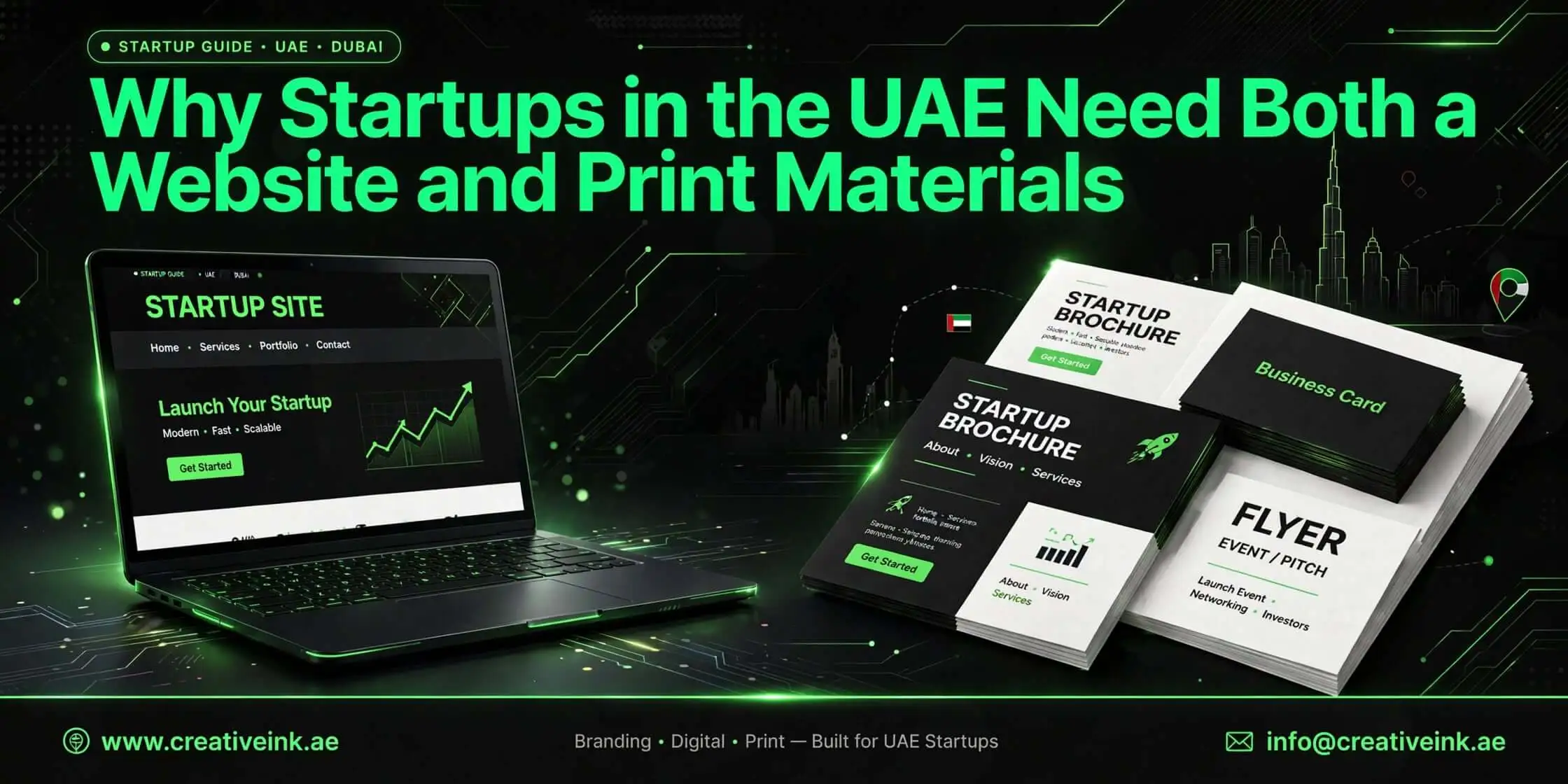
Why Startups in the UAE Need Both a Website and Print Materials
Two startups walk into the same networking event at DIFC. One hands over a sleek business card. The other says, “Just Google me,” but when the prospect does, the website looks half-built and last updated 2 years ago. Guess which one gets the follow-up call.
This happens more than founders like to admit. In the UAE, where first impressions move fast and competition is everywhere. How you show up online and offline tells people whether you’re worth their time before you’ve said a word. UAE startups website and print materials aren’t two separate things to tick off a checklist. They’re the same trust signal, split across two touchpoints. And if either one is missing, your brand pays for it.
What Makes the UAE Market Different for Startups
The UAE has a 99% internet penetration rate, one of the highest in the world. That means almost every person your startup is trying to reach is online, actively checking brands before they respond to an email, accept a meeting, or sign anything. Your digital presence is not a nice-to-have; it is being looked at right now by someone you haven’t spoken to yet.
But here’s what makes this market different from most. The UAE runs on events like GITEX, Cityscape, Arab Health, Dubai Expo activations, and Chamber of Commerce mixers. The calendar never really stops. Business here still happens face to face, over handshakes and exchanged cards, in rooms full of people from thirty different countries. That multicultural reality adds another layer: your brand needs to communicate clearly and professionally to an audience with very different expectations. In a market this active and this competitive, credibility is decided quickly, sometimes in the first thirty seconds of an interaction, online or off. This is why we can say that for UAE startups website and print materials play a key role in their respective aspects.
Why a Website Alone Won’t Hold Your Brand Together
In the UAE, most deals don’t start with a Google search. They start with a referral, a conversation at an industry event, or an introduction through a mutual contact. The digital side comes second, but it still has to be there and it has to be good.
When You Show Up Online But Not Offline
Imagine someone visits your website, likes what they see, and agrees to a meeting. You show up with nothing. No company profile, no brochure, and no card. That gap is noticed. In a market where professionalism is expected from day one, arriving unprepared physically sends a quiet message that your startup isn’t quite ready.
When You Show Up Offline But Not Online
Flip it the other way. Someone receives your business card at an expo, finds it interesting, and searches your name that evening. If your website looks unfinished or doesn’t reflect the quality of your card, the trust you built in person evaporates before you’ve had a chance to follow up.
Why Physical Materials Still Carry Weight
Startups already carry a perception risk. Clients are naturally cautious about working with a new business. A professionally printed brochure or company profile quietly removes that hesitation. It signals that you are organised, invested, and serious. Many startups skip this, treating it as an unnecessary cost. But cutting corners on design services at this stage affects how your entire brand is perceived, not just the printed piece itself.
Print also behaves differently from digital. A brochure sits on a desk for weeks. A business card stays in a wallet. A custom website tab gets closed in seconds.
When Print Has No Website to Back It Up
A well-designed brochure can start a conversation. It cannot finish one.
Print Creates Interest. Websites Close It.
When someone picks up your flyer at an event or walks away with your business card, the first thing they do when they get back to their desk is search your name. That moment, between receiving your print material and finding your website, is where startups either gain trust or lose it completely.
What Happens When There Is Nothing to Find
If your website is outdated, generic, or doesn’t exist, the impression your brochure built disappears in seconds. In the UAE’s B2B space, especially, buyers and partners research before they ever respond. They want to see your work, read about your services, and get to know who you are before they reply.
Your Website Is Where Proof Lives
Print gets you noticed. Your website is where the details are, including portfolio, client results, service breakdowns, and contact information. That is what turns interest into an actual conversation. One without the other leaves people curious but unconvinced.
How a Website and Print Materials Work Together
Most startups treat their website and print materials as two separate tasks. They are designed at different times, by different people, with different briefs. The result is a brand that feels inconsistent. Your business card uses one font, your website uses another. Clients notice, even when they can’t explain why something feels off.
The Trust Loop
Your website builds credibility before someone meets you. Your print materials reinforce it when they do. Together they create a loop. Digital discovery leads to in-person interaction, which leads back to online research, and at every stage your brand looks and feels t same.
For UAE startups specifically, this matters more than most founders realise. Decisions here move through both channels. If UAE startups website and print materials are telling two different visual stories, that decision cycle breaks somewhere in the middle.
What Consistency Actually Looks Like
- Same colour palette across your website, cards, and brochures
- Same typography with nothing borrowed from a different brand
- Same tone so your site and your printed profile should feel like the same business
A startup that gets this right looks established. One that doesn’t look like a side project.
Working with a reliable website design company at this stage ensures your digital and physical materials are built from the same visual foundation. So every touchpoint says the same thing about your brand.
What to Focus On When The Budget Is Limited
Not every startup can build everything at once, and that is fine. The mistake is splitting a limited budget thin across both and ending up with two mediocre outputs instead of one strong one.
A simple rule: if your business runs primarily on online social media, LinkedIn, or email outreach, build your website first, then add print. If you rely on in-person meetings, events, or B2B referrals, start with a clean set of print materials and a simple landing page.
Either way, your minimum should be a solid website, a business card, and one well-designed company profile or brochure. For UAE startups, website and print materials done right at a smaller scale will always outperform a rushed attempt at doing everything at once.
Frequently Asked Questions!
Do UAE startups really need print materials in 2026?
The UAE runs on events, expos, and in-person meetings. Showing up without print materials leaves a visible gap in how your brand is perceived offline.
Which comes first, a website or print materials?
Depends on how you generate business. Digital-first startups should build their website first. If you rely on meetings and referrals, start with print and a simple landing page.
How do I keep my website and print materials consistent?
Start with a basic brand guideline. Logo, colours, fonts, and tone. Apply the same rules to every touchpoint, digital and physical.
Final Thought
The startups that build trust fastest in the UAE are not always the ones with the biggest budgets or the boldest ideas. They are the ones that show up consistently in every room they walk into and on every screen someone opens.
Your website and your print materials are your brand when you are not there to represent it yourself. A prospect Googles you at midnight. A potential partner glances at your brochure between meetings. In both moments, your brand is either building trust or losing it.
It is quite evident that for UAE startups website and print materials are both equally important until they are getting the right message across.

As a seasoned content creator for Creative Ink UAE, I write about everything from cutting-edge design tips to print marketing best practices. Drawing from experience with Dubai’s top design and printing agencies, I aim to educate and inspire business owners and creatives with blog posts that simplify complex topics and spark new ideas.